
Reviewed · JEWISH QUARTERS AND OLD TOWN WALKS
Private Tour Jewish Quarter, center and Plaza de España
Jewish Seville clicks into place fast. This private, English-language walk connects the story of Seville’s Jewish communities with the city’s big artistic landmarks, from synagogue remains to Murillo-related stops. I especially like the way the route makes history feel local, not textbook, and the guide keeps the pacing easy for real wandering.
Two things I really liked: the mix of places you can see right now, like Santa Maria la Blanca and the neighborhood courtyards, plus the cinematic pop-culture references (Rosina and Figaro) that make the streets memorable. One drawback to weigh: it is only about 2 hours, so you get smart highlights, not an all-day, slow-motion soak at every monument.
In This Review
- Key highlights at a glance
- A 2-hour route that goes Jewish Quarter to iconic Plaza
- Plaza de Santa Cruz to the shared religious “square”
- Santa Maria la Blanca: synagogue remains, then Murillo in the church
- City walls, gates, and the Sephardi enclosure story
- Courtyards and narrow streets, with Rosina and Figaro energy
- Pogroms, expulsion, and Susona’s legend
- The neighborhood as a stage: Opera City, UNESCO vibes
- Cathedral-area views and the World Heritage surrounding cast
- From historic center to Torre del Oro and the Ibero-American Exposition shift
- Universidad de Sevilla in the old Royal Tobacco Factory, and why Carmen matters
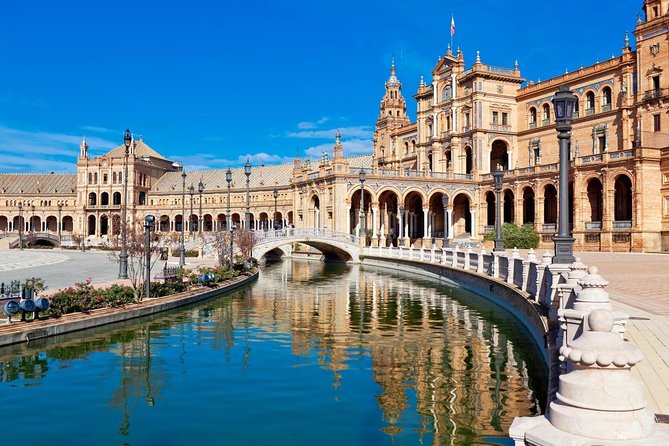
- Parque de María Luisa and Plaza de España: ending where Seville looks staged
- Price and pacing, plus whether it fits your Seville trip
- Should you book this Jewish Quarter to Plaza de España tour?
- FAQ
- How long is the tour?
- How much does the tour cost?
- Is the tour private?
- Where do we meet and where does it end?
- What language is the tour offered in?
- Are there any free admission stops?
- Can I cancel for a full refund?
Key highlights at a glance
- Santa Maria la Blanca synagogue site, then you enter the current church and see Murillo works
- City walls, gates, and Sephardi life with key stops, including a look at the necropolis area
- Golden Age street theater moment with Don Juan by his statue
- Courtyard views and narrow streets that help you picture old Seville life
- Pogroms, expulsion, and Susona’s legend told in a clear, human way
- Plaza de España finish with World Heritage surroundings nearby (Cathedral, Giralda, Real Alcázar, Archivo de Indias)
A 2-hour route that goes Jewish Quarter to iconic Plaza
This tour is designed like a strong walking thread: start in the historic core at Plaza de Santa Cruz, then move through the Jewish Quarter streets toward the Plaza de España setting in Parque de María Luisa. It runs for about 2 hours, so you will spend most of your time actually walking, turning corners, and stopping where the story makes sense in the street.
The sweet spot here is focus. Instead of splitting your time across too many distant stops, you get a tight arc from medieval community life, to famous Seville art, to the city’s later global-era makeover tied to the Ibero-American Exposition. If you like history but hate slow, repetitive lectures, you will appreciate the momentum.
Also, it is private. That means your group controls the vibe, and your guide can adapt if you want extra photos in a courtyard or an extra minute at a viewpoint.
Plaza de Santa Cruz to the shared religious “square”
Your walk starts where Seville’s layers are easiest to feel. Early on, you get context for the Jewish presence in the city and how multiple religious communities were connected through space. The guide points out that in one shared square you could find the footprint of a mosque, a synagogue, and a church, representing overlapping eras rather than isolated worlds.
This opening sets up the rest of the route. You start paying attention to how buildings and neighborhood layouts keep memory alive. It also introduces the art angle early, including mentions of Murillo, one of Spain’s best-known painters, whose presence shows up again later.
Tip for you: in the first 10 to 15 minutes, listen for the guide’s framing, not just names. When you understand the “why” behind each stop, the rest of the walk lands much harder.
Our remaining Jewish Quarters and Old Town Walks notes, in case one suits you better



Santa Maria la Blanca: synagogue remains, then Murillo in the church
One of the most important stops is the Iglesia de Santa Maria la Blanca. This is where you can connect the dots between the older synagogue site and the religious building you see today. The tour explains how plaques and signage relate to the wider network of Jewish quarters across Spain through Caminos de Sefarad, which helps you see Seville as part of a bigger map.
Then you get in. The current temple is not just a facade stop. You will also see exhibited Murillo works, and this is a smart pairing: it shows how Seville’s story moves from Jewish community roots into the Christian city that became famous for art and style.
One practical note: since you enter a church, dress with normal respect. Shoulders and knees are the safest bet. And if you tend to get cold in shaded interiors, bring a light layer.
City walls, gates, and the Sephardi enclosure story
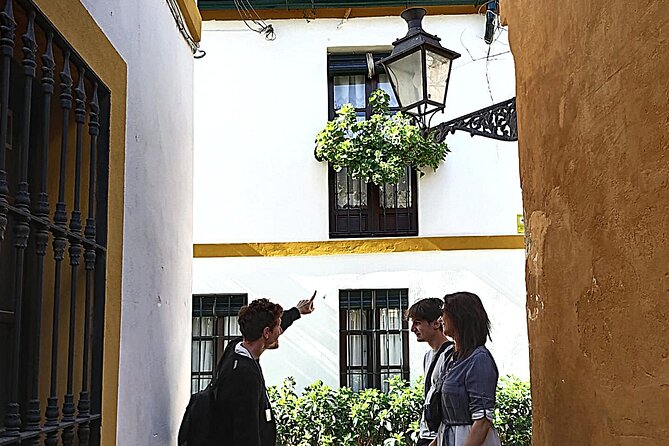
As you walk onward, the focus shifts outward, from buildings to the city’s boundaries. You will talk about the walls and gates of Seville and what the enclosed area meant for the Sephardim, including locating the necropolis area in the story.
This is the kind of stop that helps you understand why neighborhoods looked the way they did. When you know the city was shaped by walls and controlled entrances, street layouts stop feeling random. They start reading like a lived system.
You also get a Golden Age reference with Don Juan, including a pause by his statue. Even if you do not know every detail of the character, it works as a bridge into later Seville cultural fame, where literature and theater become part of the streets.
Courtyards and narrow streets, with Rosina and Figaro energy
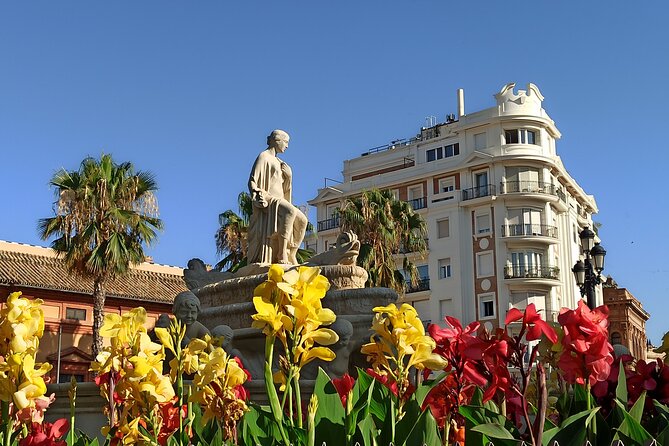
The walk keeps changing pace in a good way. You will move through the courtyards and alleys of the neighborhood, where the architecture forces you to slow down and look up. That matters in Seville, because so much of the experience is visual rhythm: white walls, shadowed patios, and sudden open-air viewpoints.
You will also see the narrowest street in the city and get a look out toward Rosina’s balcony, tied to the world of The Barber of Seville and the Figaro story. It is a fun pop-cultural moment, but the better value is how it turns a literary reference into a geographic landmark. Instead of vague “this is where the opera was,” you get an actual street cue.
And you will hear about an old Seville aqueduct. This is a useful reminder that daily life was powered by infrastructure long before modern plumbing. A quick infrastructure story like this often makes the whole medieval setting feel more believable.
Pogroms, expulsion, and Susona’s legend
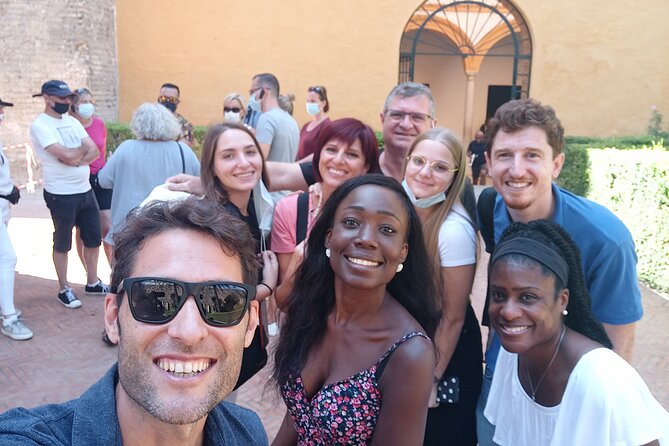
This part of the walk is heavier, but it is handled in a structured way. You will learn about the vicissitudes of the Hebrew people, with attention to the pogrom and the definitive expulsion by the Catholic Monarchs. The goal here is not shock, it is understanding how policy and violence changed life in real places, including what happened to communities.
Then the tour brings in Susona, described as a beautiful figure and legend tied to the neighborhood. Legends are not “proof” in the historical sense, but they can be useful cultural tools. In this case, Susona helps you connect emotions and memory to a time period that can otherwise feel too large to picture.
If you are sensitive to difficult history, you might want to mentally prepare for this section. The route does not skip it, but your guide’s job is to make it clear and human rather than sensational.
The neighborhood as a stage: Opera City, UNESCO vibes
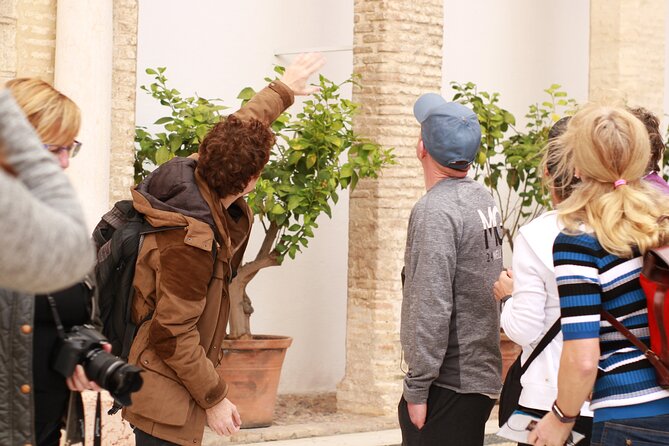
One of the most enjoyable parts of the walk is when the guide shifts from tragedy to the neighborhood’s later creative life. The Jewish Quarter streets are described as a stage for European artists who used Seville settings for plays and novels, which is why you hear about the area as the City of Opera linked to UNESCO.
You will walk through streets where you can almost “stage” scenes yourself. You get that sense of narrow passages, sudden squares, and viewpoints that look designed for the theater, even though they obviously grew from everyday life first.
For you, this section is a reminder to stay present. Take a few minutes just to watch the street activity and notice how the buildings frame sight lines. That is the fastest way to make the history stick.
Undecided so far? The rest of our Private coverage in Seville
- Seville: Private City Tour by Eco Tuk Tuk
- Tour Welcome Seville with Local Guide in Eco Tuk Tuk Private
- Private Seville Tapas & History Tour
- Seville Private Walking Tour with Alcazar & Cathedral Tickets
- Private White Villages & Ronda Day Tour from Seville
- Private Walking Tour Alcazar and Cathedral in Sevilla
- Private Guided Day Trip to the White Villages and Ronda from Seville
- Alcazar and Cathedral of Seville Private Tour
Cathedral-area views and the World Heritage surrounding cast
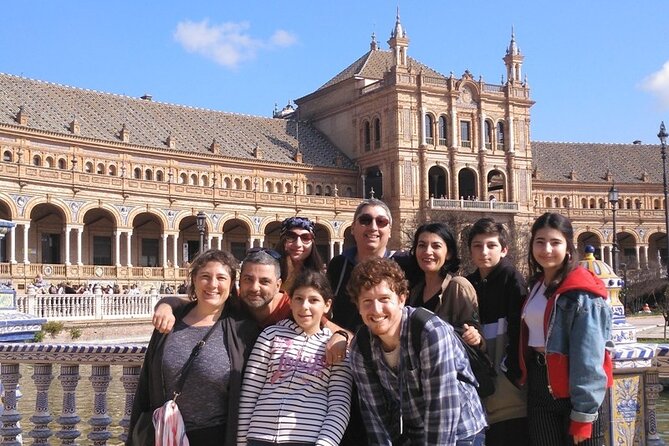
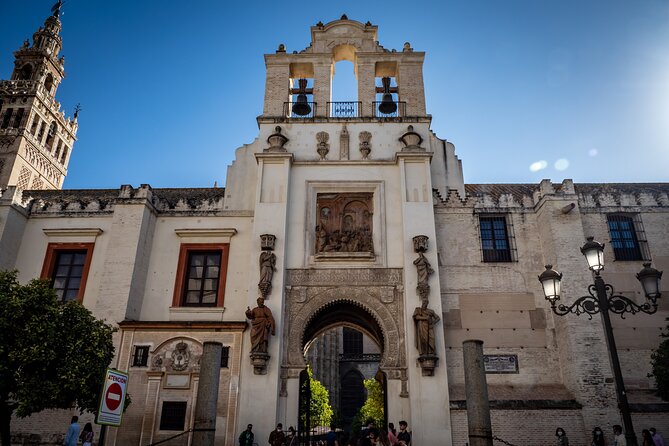
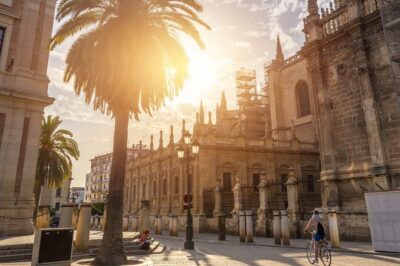
At a viewpoint, you will get a satisfying payoff. You will see a view surrounded by the Cathedral, Giralda, Real Alcázar, and Archivo de Indias. These are part of the World Heritage surroundings mentioned on the tour, and the effect is practical: you get a sense of where your earlier medieval storytelling sits in today’s Seville power map.
Why this matters: people often visit these monuments separately, but here you see them as neighbors in the same city story. It helps you build a mental map fast, which is gold if you have only a couple days in town.
If you plan to photograph, arrive ready. You will likely want your camera or phone at chest level and ready to shoot quickly, because the tour pacing here is designed to keep momentum.
From historic center to Torre del Oro and the Ibero-American Exposition shift
After the core medieval feel, the route expands outward to show Seville’s later transformation. You will leave the historic center to understand the relevance of Torre del Oro, then connect that to the city’s reconfiguration about a century ago during the Ibero-American Exposition.
You will also hear about notable changes and buildings linked to that era, including the Alfonso XIII hotel and the layout of important avenues such as Constitution. This part is for your bigger-picture understanding. Seville did not just preserve old walls and alleys, it kept rebuilding itself for new audiences and new global connections.
If you like urban history, this is one of the most “useful” sections because it gives you a reason to look at modern street geometry instead of only focusing on old stone.
Universidad de Sevilla in the old Royal Tobacco Factory, and why Carmen matters
Next, you stop at Universidad de Sevilla. The tour explains that its headquarters sit in the old Royal Tobacco Factory, and ties the space to French literary influence. You will hear that Mérimée was inspired to create Carmen based on this setting.
This is a smart intersection point: it connects politics and administration, like French support for manufacturing models, and Spanish adoption of such approaches under the Bourbons. You also get literary details tied to renowned French authors.
What I like about this stop is how it widens the story. Jewish Seville is the core theme, but Seville’s evolution is also about trade, industry, and the writers who came into contact with the city’s atmosphere.
Parque de María Luisa and Plaza de España: ending where Seville looks staged
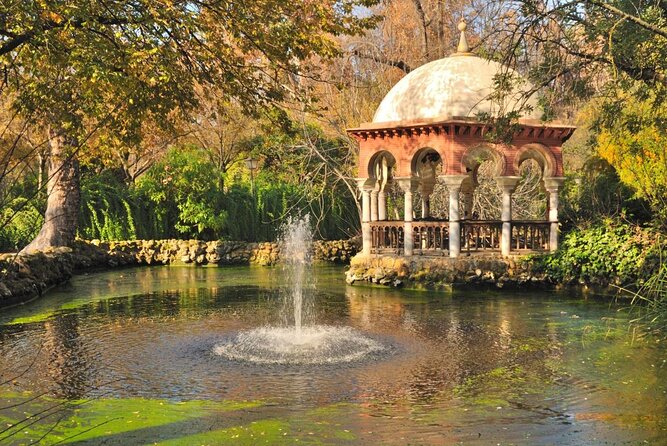
The tour concludes at Parque de María Luisa, and you end at Plaza de España. You will learn that the park was owed to a French garden architect named Forestier, which immediately gives you a new lens for what you are seeing. The beauty is not random landscaping, it is planned.
Later, the Ibero-American Exposition brought pavilions here, and you will specifically connect the setting to the pavilion connected to Spain, which gives its name to the current Plaza de España. This is one of those endings that feels like a reward because you get a wide stage after a walk through narrow streets.
Practical tip: arrive ready to linger for a few minutes on your own after the guide finishes. Plaza de España can reward slow looking, especially if you like architectural symmetry and photo-friendly corners.
Price and pacing, plus whether it fits your Seville trip
The price is $189.87 per group, up to 12 people, and the tour lasts about 2 hours. That price structure matters. If you are traveling as a duo, it will feel premium. If you have a family or small group closer to 8 to 12 people, the cost per person becomes much easier to swallow.
If you book near a full group of 12, you are effectively spreading the cost to about $15 to $16 per person using the stated cap. With 4 people, it is more like $47 to $48 each. So ask yourself one question: is this tour for your whole group, or is it just you two?
Pacing is also the deciding factor. Two hours means you will see the main hits and understand the connections, but you will not have time to wander and re-enter every site at your own pace. This is ideal if you want to build a map of Seville fast and then return later for deeper monument time.
Who it suits best:
- First-timers who want a strong story thread through Seville’s historic neighborhoods
- Small groups who want privacy, not a crowded “grab and go” experience
- People who like art history connections, especially Murillo references
- Anyone curious about how Seville’s identity evolved from medieval community life to later global-era presentation
One more practical detail: the tour is offered in English, and you get a mobile ticket. Service animals are allowed, and the route is near public transportation, which helps if you are combining it with other parts of your day.
Should you book this Jewish Quarter to Plaza de España tour?
I think you should book this if you want Seville to feel connected, not chopped into separate sites. The route is built around relationships, like shared spaces, community enclosure, and later cultural shifts, plus you end in one of the city’s most cinematic plazas.
I would skip it only if you want a super slow, in-depth museum-style experience or if you already know you want to spend long hours inside major monuments. This tour is about walking, understanding the why behind the places, and finishing with big views.
If your group is small and you can pay for privacy, it can be a smart way to get orientation. And if you are a group of 6 to 12, it becomes a very good deal for a structured, private, English-language introduction to Seville’s Jewish Quarter story and its stunning modern stage setting at Plaza de España.
FAQ
How long is the tour?
It is approximately 2 hours.
How much does the tour cost?
It costs $189.87 per group, up to 12 people.
Is the tour private?
Yes. It is a private tour, and only your group participates.
Where do we meet and where does it end?
Meet at Plaza de Santa Cruz and end at Plaza de España, in the gardens of María Luisa.
What language is the tour offered in?
The tour is offered in English.
Are there any free admission stops?
Yes. The stops listed with admission tickets marked free include Iglesia de Santa Maria la Blanca, Universidad de Sevilla, and Parque de Maria Luisa.
Can I cancel for a full refund?
Yes, free cancellation is available. You can cancel up to 24 hours in advance for a full refund.
Further Private we have reviewed in Seville
- Seville: Private City Tour by Eco Tuk Tuk
★ 4.8 · 963 reviews - Tour Welcome Seville with Local Guide in Eco Tuk Tuk Private
★ 5.0 · 786 reviews - Private Seville Tapas & History Tour
★ 5.0 · 380 reviews - Seville Private Walking Tour with Alcazar & Cathedral Tickets
★ 5.0 · 332 reviews - Private White Villages & Ronda Day Tour from Seville
★ 5.0 · 243 reviews
Tours: the rest of our Seville write-ups
- Seville: Cathedral, Giralda, and Royal Alcázar Guided Tour
★ 4.7 · 9,165 reviews - Seville: Cathedral, Giralda & Alcazar Entry With Guided Tour
★ 4.6 · 8,560 reviews - Seville: Priority Access Cathedral, Giralda & Alcázar Tour
★ 4.8 · 7,563 reviews - Seville: Alcázar and Cathedral Entry Ticket and Guided Tour
★ 4.6 · 5,056 reviews - Seville: City Sightseeing Hop-On Hop-Off Bus Tour
★ 4.0 · 4,633 reviews
Our other Jewish Quarters and Old Town Walks, side by side
- Cordoba & Carmona with Mezquita, Synagoge & Patios from Seville
★ 4.5 · 1,126 reviews - Seville: Small-Group Jewish Quarter Discovery Walking Tour
★ 4.9 · 499 reviews - VIP Guided Seville Alcazar Pre-Opening, Cathedral & Old Town
★ 5.0 · 191 reviews - Seville: Small Group Jewish Quarter Tour with Tapas & Drinks
★ 5.0 · 119 reviews - Seville Jewish Quarter Small Group Tour with Tapas and Drinks
★ 5.0 · 110 reviews
Fresh off the desk: recent Seville experiences we have written up

Jewish Quarters and Old Town Walks, side by side.
 ★ 5.0Barcelona in 1 Day: Sagrada Familia, Park Guell,Old Town & PickupFrom $12013,541 reviews
 ★ 5.0Toledo Tour from Madrid: Cathedral, Synagogue & St. Tome’s ChurchFrom $816,784 reviews
 ★ 4.7Córdoba: Jewish Quarter, Mosque, and Alcázar TourFrom $504,279 reviews
 ★ 5.0Valencia Old Town Tour with Wine & Tapas in 11th Century Historic MonumentFrom $963,234 reviews
 ★ 4.6Cordoba Mosque & Jewish Quarter Tour with TicketsFrom $401,996 reviews
 ★ 4.5Madrid Old Town & Royal Palace Walking Tour Skip the Line TicketFrom $401,829 reviews
 ★ 4.9Valencia: Old Town Tour, Wine & Tapas in an 11th c. MonumentFrom $941,797 reviews
 ★ 4.7Barcelona: Sagrada Familia, Modernism, and Old Town TourFrom $521,621 reviews
This tour also sits in