
Reviewed · JEREZ, SHERRY AND ANDALUSIAN HORSES
Jerez de la Frontera: How the Andalusian Horses Dance
Horses do ballet in Jerez. This show at the Fundacion Real Escuela Andaluza del Arte Ecuestre is a polished equestrian performance, and I love how classical dressage meets pure Spanish energy with Andalusian horses that look made for this kind of work. The main thing to watch out for is simple: you buy by price category, and you cannot choose your exact row or seat number.
What makes it special is that the choreography is built from real riding disciplines, not just tricks. You will see pirouettes, pas de deux style moments, carriage work, and exercises performed in hand, all stitched together with quintessential Spanish music and traditional 18th-century costumes.
If your time is tight, the biggest consideration is choosing the right showtime. The program can also change, so don’t plan your entire day around one single last-minute expectation.
In This Review
- Key things to know before you go
- Horses dancing at the Royal Andalusian School, not a random arena show
- What the 90 minutes to 2 hours actually feels like
- The choreography menu: Doma Vaquera and classical dressage highlights
- Doma Vaquera: one-hand riding and cattle-herding roots
- Classical dressage: advanced exercises to classical music
- Watching horses in motion: carriage driving and the wow factor
- Working in hand: when the rider is not on the saddle
- The carrousel finale and why the group matters
- Costumes and Spanish music: why it matters for your enjoyment
- Seating strategy when you can’t pick your row
- What to bring, what to avoid, and the small rules that matter
- Adding the show to a Jerez day (or a Cadiz side trip)
- Special dates: 4 European riding schools gala in late June and early July
- Value check: is this worth the roughly $31 per person?
- Should you book this experience?
- FAQ
- Where is the meeting point for the show?
- How long is the performance?
- Do I need to bring anything with me?
- Can I take photos with flash or record audio?
- Are pets allowed in the venue?
- Is the venue wheelchair accessible?
Key things to know before you go
- You’ll watch 6 to 8 different choreographies in a single performance, so it never drags.
- The repertoire mixes disciplines like Doma Vaquera, classical Haute Ecole dressage, and carriage driving.
- Costumes and music do real work by reinforcing the eras and styles behind the movements.
- Some shows run longer than 90 minutes, so build in a comfortable buffer.
- Seats are assigned by booking order within categories, so earlier booking can mean better placement.
- No flash photography, audio recording, or pets, so plan accordingly before you arrive.
Horses dancing at the Royal Andalusian School, not a random arena show
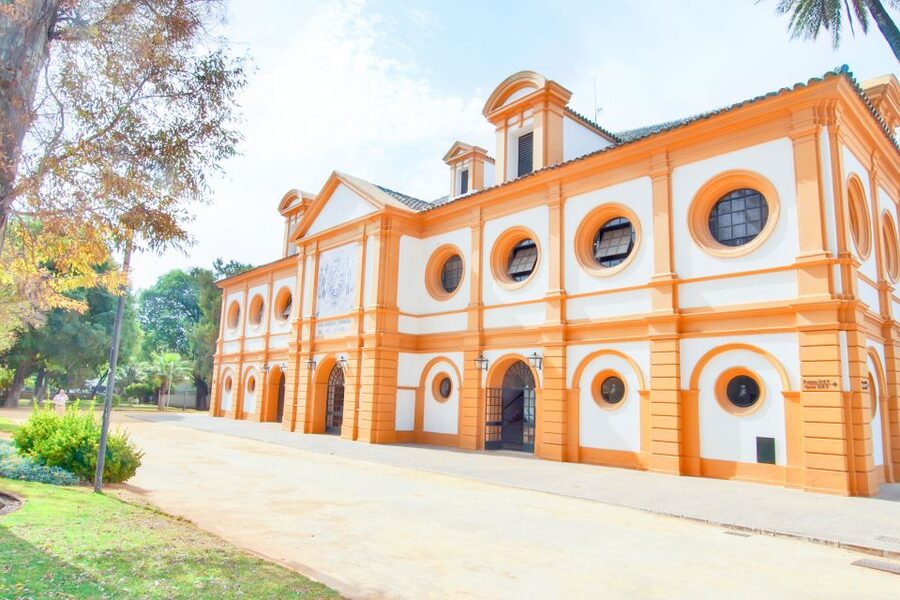
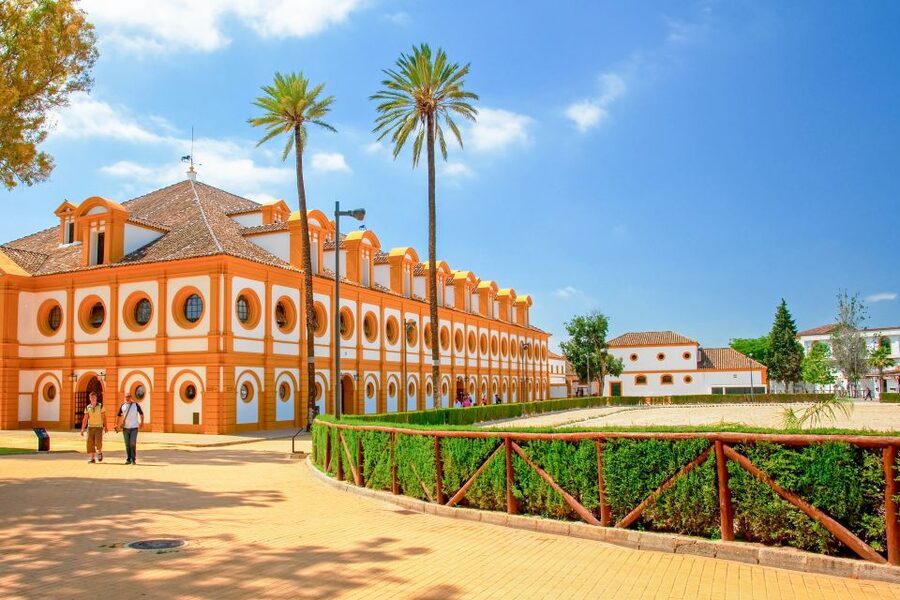
The Fundación Real Escuela Andaluza del Arte Ecuestre is where this style belongs. You are not just watching horses perform for applause. You are watching a school that trains horses for advanced movements, and then stages those skills as a show with drama, pacing, and period-inspired presentation.
I especially like the way the performance feels like it has chapters. One segment might focus on rhythm and changes of pace. Another highlights precision between partners. Then you switch gears to carriage driving, where you see a different kind of athletic control.
From the on-site vibe I think you will also appreciate the chance to look around before and after. Many people come away saying the grounds and the training activity make the visit feel bigger than the show itself.
What the 90 minutes to 2 hours actually feels like
The performance window is listed as 90 minutes to 2 hours, and the exact length can vary by show and program. Plan to treat it like a full event, not a quick stop. Even if you arrive a little early, you can use that time to take in the venue and watch riders and trainers in action.
Inside the arena, the show structure is built from multiple choreographies. Each one is anchored in a discipline from Andalusian riding culture. That matters because you are not just seeing movement. You are seeing why the movement exists, even if it is presented in show-ballet form.
Also keep an eye on the fact that the management reserves the right to alter or change the program. That sounds like a disclaimer, but it is also a reality of live training environments. If you go expecting the program to be frozen in time, you might be disappointed. If you go expecting an excellent sequence of equestrian highlights, you will be happy.
The choreography menu: Doma Vaquera and classical dressage highlights
The show’s core repertoire is scheduled by the school and typically includes 6 to 8 choreographies. This is where the experience earns its value. You get variety, and the variety is the point.
Doma Vaquera: one-hand riding and cattle-herding roots
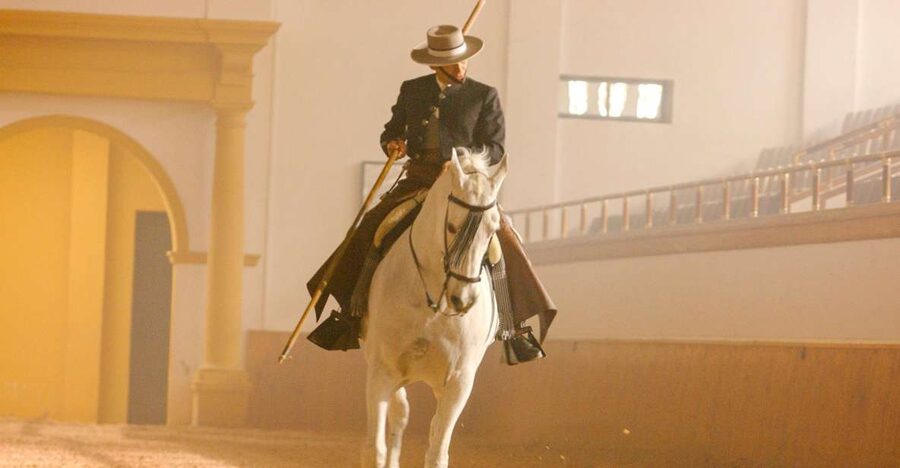
Doma Vaquera is described as a Spanish riding discipline based on traditional cattle herding. In the arena, you see the rider work around using only one hand, starting with trotting and then moving into galloping. The emphasis is on rhythm and transitions.
Where it gets fun for spectators is when the rider changes tempo and the horse executes pirouettes and arreones. An arreon is the horse breaking into a gallop, so you feel a quick surge in energy rather than a slow, stately pace. If you like horses that show personality and athletic bite, this segment is often the one that hooks you first.
Classical dressage: advanced exercises to classical music
Then the program shifts toward classical dressage with choreographies such as The Colts, Airs on Horseback, Pas de Deux, Passage and Piaffer, Domino on Horseback, Airs Above the Ground, and Fantasy.
Even if you are not a dressage person, you can still enjoy it because classical music gives you a framework. Movements like passage and piaffer are about controlled elevation and cadence. Piaffer work, in particular, often reads visually as the horse engaging with the space in front of it, not just moving forward.
And the show uses the names for a reason. Pas de Deux is there to spotlight partner dynamics and coordination. Airs above the ground and fantasy-style segments highlight elevation and theatrical timing. The point is not to make it abstract. The point is to translate training into something you can understand in real time.
Watching horses in motion: carriage driving and the wow factor
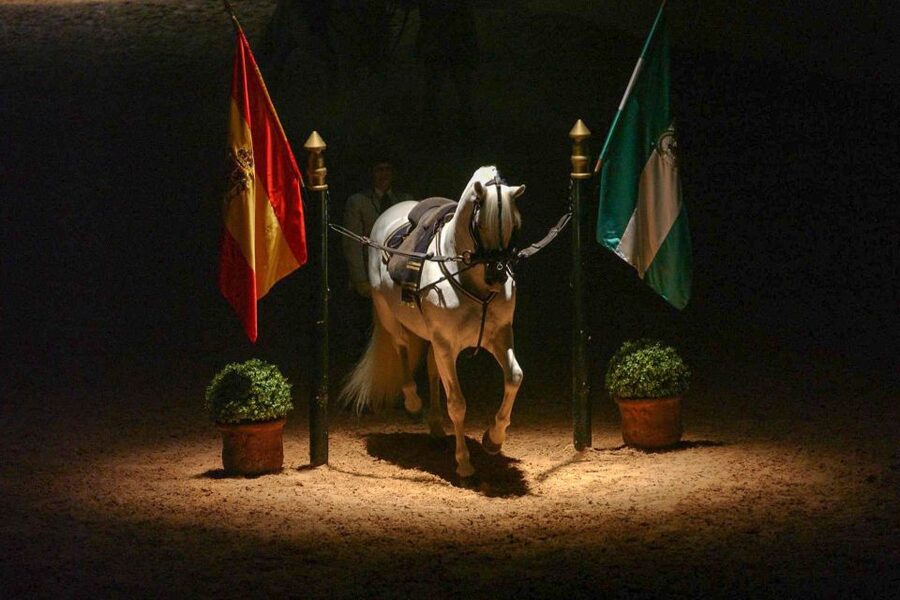
Carriage driving is one of the segments that surprises people. The description notes that these horse-drawn carriages were originally used for transport, but now they are sport and exhibitions, with classical harnesses and coachmen demonstrating skills.
When it works, it is not just about speed. It is about control. You see how the horse responds to the coachman’s cues while moving and managing the harness. It’s also a nice contrast after dressage work, because carriage segments tend to emphasize steadiness and coordination with equipment.
If you are the type who loves seeing multiple sides of horsemanship in one sitting, carriage driving is a strong reason to go even if you think you only care about dressage.
Working in hand: when the rider is not on the saddle
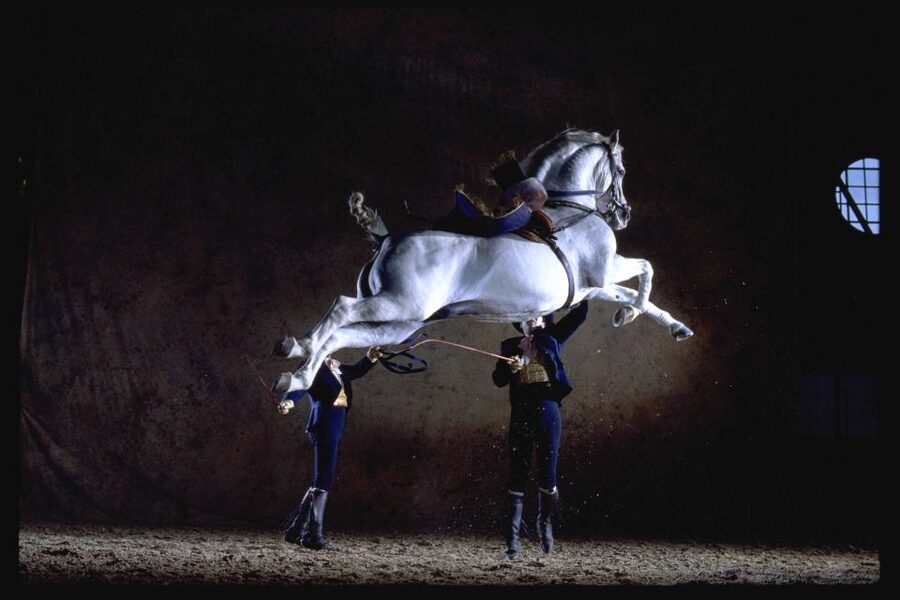
One of the most compelling parts of the program is working in hand. The premise is straightforward: the horse obeys its handler even when the horseman is not in the saddle.
This is where you start noticing the training relationship as something more than just mounted riding. The horse is still executing Haute Ecole style dressage exercises, including levades, caprioles, courbettes, piaffe between pillars, and the Spanish walk.
Even if the names are new to you, the movements are visually distinct. Levades and caprioles are about lift and spring. Piaffe between pillars adds geometry, because you are watching the horse negotiate a structured space while keeping cadence. The Spanish walk reads more like a signature gait, slower and more deliberate, so it gives your eyes a rest before the faster highlights.
The carrousel finale and why the group matters
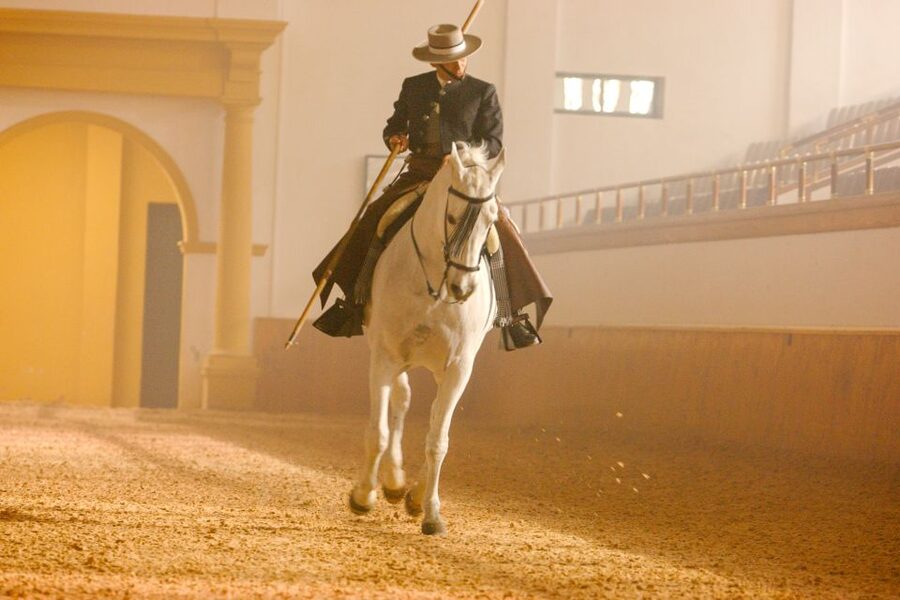
The show ends with a carrousel. This is described as a group of horses and riders performing advanced equestrian exercises in unison.
I like this ending because it locks in the theme of training as teamwork, not just individual talent. Earlier segments showcase specific discipline skills. The carrousel compresses all that into a single, visible pattern. If you like clean formations, synchronized timing, and that satisfying sense of coordination, this finale is a strong closer.
Costumes and Spanish music: why it matters for your enjoyment
You get traditional 18th-century style costumes and quintessential Spanish music. That sounds like decoration, but it affects how you read the choreography.
Costumes help you understand the vibe of each segment, especially when the program shifts between riding disciplines that evolved in different contexts. Music does the bigger job: it signals the pacing and energy before you even register every movement detail.
So even if you miss a technical term, you still feel what the show is trying to do. It is also part of why the show works for first-timers and seasoned horse people alike.
Seating strategy when you can’t pick your row
Tickets are sold by category, and you do not get to choose row or seat number. Seats are allocated according to order of purchase or booking.
Here’s my practical advice: if you care about tight views of horse movements and want fewer obstacles, book earlier within your budget. If you are more focused on the overall flow and you can accept sitting a bit farther back, any category can still be worthwhile. One of the most common compliments is that viewing is good even when you are not in the absolute front.
Also remember you cannot plan like a stadium concert where you can gamble on where you sit. If you are traveling with friends and need to sit together, this ticketing structure may affect how your group ends up. Plan your group booking carefully.
What to bring, what to avoid, and the small rules that matter
This is an arena show, so your preparation is simple, but the rules are real.
Bring a passport or ID card. Also, the venue states that it is essential to present your printed voucher at the ticket office.
As for what is not allowed:
- Flash photography
- Audio recording
- Pets
- Glass objects
- Weapons or sharp objects
- Bottles, cans, animals, or any other items the management considers unsuitable
If you rely on your phone camera for photos and video, you will need to adjust. Normal non-flash viewing and photos may be possible depending on on-site rules, but the data explicitly calls out no flash photography, and it also bans audio recording.
One more practical tip: if you like souvenirs, show up with enough time to browse after. Some people have noted that the gift shop can close earlier than expected, so build in time rather than assuming it will be open right after the show.
Adding the show to a Jerez day (or a Cadiz side trip)
Jerez is a natural home for this performance, but the venue is also easy to combine with other Andalusian highlights.
If you are basing in Cadiz, one review points out an easy train ride to Jerez and then a quick cab ride to reach the show. That’s a very workable pattern if you want one memorable evening without overcomplicating logistics.
Within Jerez, the show is also a good anchor point. You can wander first, watch some training activity, then settle in for the main event. The whole visit feels like it has layers instead of just being one seated act.
Special dates: 4 European riding schools gala in late June and early July
There is an additional highlight if your timing matches. On June 30 and July 1, at 9 p.m., the Four Equestrian European Schools perform together for the first time, with Austria, France, Spain, and Portugal participating.
The program also notes that the Abu Dhabi International Riding School will join under supervision and training of the Royal Andalusian School of Equestrian Art. It is described as a historical event, and it includes expanded seating, a leisure and catering space, and 4000 seats in stands on an outdoor arena next to the Álvaro Domecq riding arena.
If you are traveling around that window, it may be worth checking those options specifically, since it is not just the standard show setup.
Value check: is this worth the roughly $31 per person?
At around $31 per person, this is priced like a major cultural attraction rather than a bargain novelty. And based on how the show is built, it makes sense.
You get:
- An organized program of 6 to 8 choreographies
- Multiple riding disciplines in one performance
- Traditional costumes and authentic Spanish music as part of the experience
- A venue where people can also walk around and see riders and trainers around the event
The best value angle is that the show is not one trick. It is a sequence of different equestrian skills, including mounted work, in-hand exercises, and carriage driving. That variety is what keeps the ticket from feeling like a one-note experience.
If you are traveling with kids who love animals, or adults who want one standout Andalusian evening without needing special training knowledge, this is a strong pick.
Should you book this experience?
If your idea of a great night in Andalusia includes horses, performance, and discipline you can actually see, I’d book it. The mix of Doma Vaquera, classical dressage highlights like Pas de Deux, working in hand, and carriage driving gives you enough variety that you likely won’t feel bored even if you are not a dressage expert.
I would not make it your only plan if your schedule is extremely tight or if you strongly dislike fixed seating categories. Also, because the program can change, don’t treat the show like it is guaranteed to match one exact list of segments.
Bottom line: this is a practical, high-satisfaction evening in Jerez. For many visitors, it is the kind of show they remember for years, and it is easy to justify at this price.
FAQ
Where is the meeting point for the show?
Go to the Reservation Box Office at the Royal Andalusian School of Equestrian Art Foundation.
How long is the performance?
The show runs about 90 minutes to 2 hours. Check availability to see the starting times.
Do I need to bring anything with me?
Yes. Bring a passport or ID card, and you must present your printed voucher at the ticket office.
Can I take photos with flash or record audio?
No. Flash photography and audio recording are not allowed.
Are pets allowed in the venue?
No. Pets are not allowed.
Is the venue wheelchair accessible?
Yes, the experience is listed as wheelchair accessible.
Jerez, Sherry and Andalusian Horses, side by side.
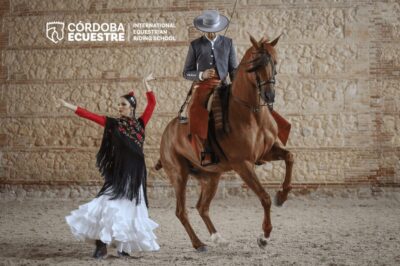 ★ 4.5Cordoba: Equestrian Show General EntryFrom $212,333 reviews
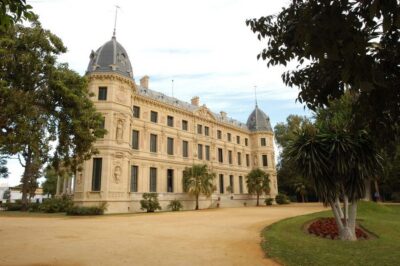 ★ 4.7Jerez de la Frontera: Andalusian Horse Dance and MuseumsFrom $381,289 reviews
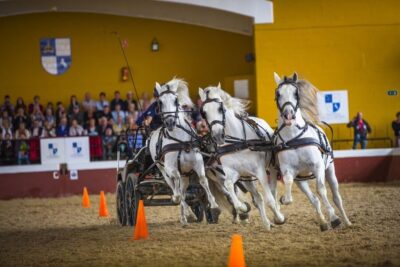 ★ 4.8Jerez: Yeguada de la Cartuja Carthusian Horses TourFrom $22970 reviews
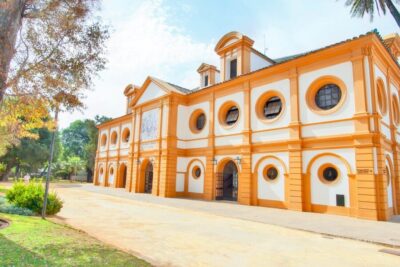 ★ 4.6Jerez: Royal Andalusian School of Equestrian Art AdmissionFrom $18882 reviews
 ★ 4.8Jerez: Bodegas Fundador Guided Tour with Tasting SessionFrom $21714 reviews
 ★ 4.4Jerez: Guided Winery Tour with Wine TastingFrom $22636 reviews
 ★ 4.2From Seville: Cadiz and Jerez de la Frontera Day TripFrom $117595 reviews
 ★ 4.5Andalusian Horses Dance ShowFrom $33483 reviews
This tour also sits in